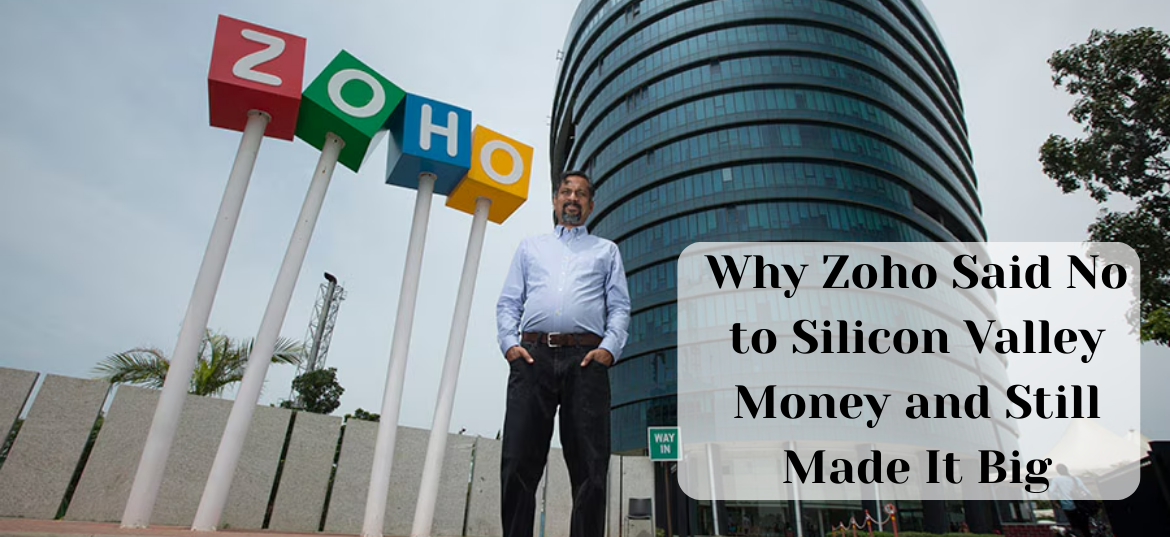
Why Zoho Said No to Silicon Valley Money and Still Made It Big
During the mid-1990s, while India’s software sector was dependent on outsourcing and catering to Western customers, young engineer Sridhar Vembu thought India could do better than code for others. He dreamed of developing products that could rival the big boys like Microsoft and Salesforce products that would boast the Made in India label, but be utilized by businesses all over the world.
In 1996, with his friend Tony Thomas, he founded AdventNet Inc. in California. Initially, the company developed network management products. The early days weren’t glitzy, no flashy venture funding announcements, no Silicon Valley hype. Just dogged attention to engineering.
By the 2000s, with cloud computing redefining business software, AdventNet changed. It was renamed Zoho Corporation in 2009 in honor of its new suite of web-based productivity apps. This was not a simple renaming; this was a statement of intentions: Zoho was going to challenge the heavy hitters in the SaaS market.
The Road Less Traveled
Unlike most Indian technology entrepreneurs of that time, Vembu followed a non-conventional route:
- No venture capital. While his contemporaries wooed Silicon Valley investors, Zoho remained bootstrapped. Each dollar it spent was a dollar it made.
- No dash to unicorn status. Growth was slow, sustainable, and customer-funded.
- No fixation with large cities. Indeed, Vembu quit the U.S. and established operations not in Bengaluru, but in a village outside Tenkasi in Tamil Nadu.
This countryside office became the emblem of Zoho’s ideology: talent can be found everywhere. Engineers were trained directly from school through Zoho Schools of Learning, avoiding costly degrees and top campuses.
Building the Operating System for Business
With the years passing by, Zoho constructed not only a product, but an ecosystem. From Zoho CRM to Zoho Books, from Zoho Mail to Zoho Projects, the company tied together a set of more than 50+ applications.
The crown jewel was Zoho One, widely referred to as the “Operating System for Business.” Rather than saddling small and medium enterprises with having to manage multiple costly tools, Zoho packaged everything from HR to accounting to collaboration into a single low-cost offering.
The pricing model was revolutionary: whereas Salesforce and Microsoft levied premium fees, Zoho opened up enterprise-quality software to small businesses everywhere.
Growth Without Noise
By 2019, Zoho quietly reached $500 million in revenue. By 2021, it had crossed $600 million. In 2023, it reached the $1 billion mark, all while remaining profitable and debt-free.
What makes this achievement remarkable is not only the figures, but how they were accomplished:
- 95% of revenue is from global customers.
- No pressure from investors to pursue vanity metrics.
- Total autonomy in decision-making.
Challenges on the Way
Needless to say, the journey wasn’t easy. Zoho had to:
- Head-on competes with Salesforce, Microsoft, and Google.
- Persuade the world that a rural Tamil Nadu company could provide world-class SaaS.
- Hold onto talent in a hyper-competitive space.
Entrepreneurial Takeaways
The Zoho narrative is not one of software rewriting rulebooks.
- You don’t need investors to build big. Bootstrapping can result in billion-dollar businesses.
- Rural talent is untapped gold. Don’t restrict recruitment to metro locations.
- Focus on affordability. Targeting SMBs overlooked by heavyweights, Zoho cultivated loyalty at scale.
- Culture > Capital. A strong value-driven culture can outlast funding cycles.
As Vembu himself says:
“If we don’t build our own technology, we will forever be dependent on others.”
A Global SaaS Giant, Rooted in a Village
Now, more than 100 million users in 150+ countries operate their businesses on Zoho. From a small office in Chennai and a village in Tenkasi, companies in New York, London, Dubai, and more are powered by Zoho.
It’s India’s response to Silicon Valley—confirmation that world-class products can be created beyond the spotlight of venture capital, beyond the din of cities, and beyond the conventional playbook.
Zoho is not just a business. It is a way of thinking. A reflection that patience, autonomy, and values can construct not only an enterprise, but an inheritance.
Social Media Handling