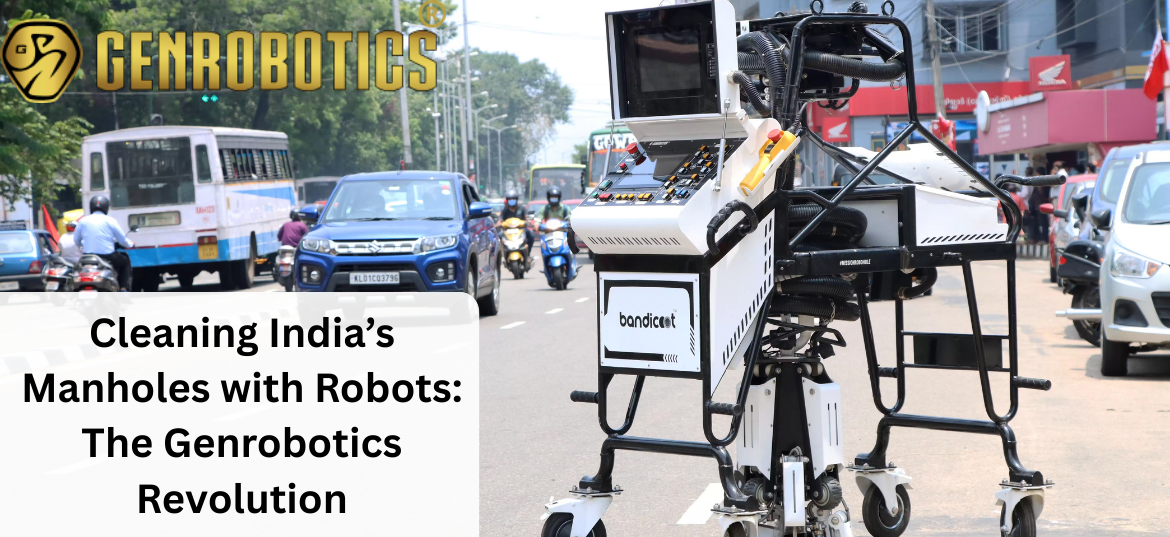
Cleaning India’s Manholes with Robots: The Genrobotics Revolution
Introduction
For decades, thousands of Indian sanitation workers lived with a barbaric reality entering manholes and septic tanks to remove human filth with their own hands. The inhuman practice, called manual scavenging, was outlawed by law, but it continued clandestinely. Behind each manhole were tales of danger, sickness, and frequent death, as laborers inhaled lethal gases or suffocated in poisonous mud. Not only was it unsafe, it robbed individuals of dignity, marking them with a stigma that they did not select.
Against this bitter reality, a band of young engineers from Kerala chose to dream otherwise. They posed a very basic yet potent question: “Why should a human life be risked for a job a machine can do?” Their response birthed Genrobotics and its revolutionary creation the Bandicoot robot, the first robotic scavenger in the world. Conceptualized to clear manholes without going in, Bandicoot revolutionized centuries of agony.
What makes this change remarkable is not only the technology, but also the empowerment involved. Sanitation workers formerly at risk of death are now robot operators trained, entering a future in which they receive dignity, safety, and respect.
Founders
Genrobotics was founded by four passionate engineers:
- Vimal Govind MK
- Arun George
- Nikhil NP
- Rajat S R
The idea originated during their college project, when they realized that manual scavenging still claimed lives in India. Their vision was to create robots that could do dangerous jobs, protecting human lives while modernizing civic systems. With early backing from the Kerala Startup Mission and later national recognition, Genrobotics transformed from a student initiative into a global social-tech leader.
The Problem & Inspiration
-
- Manual scavenging was banned in India in 1993, yet thousands of sanitation workers still clean septic tanks and manholes by hand.
- This dangerous practice has caused numerous deaths due to toxic gas inhalation.
- The team’s mission was clear: “No human should ever have to enter a manhole again.”
Thus was born Bandicoot, the robot designed to completely replace manual entry into manholes.
Business Model
Genrobotics operates on a B2G (Business-to-Government) and B2B (Business-to-Business) model:
- Government Partnerships
- Municipal corporations purchase and deploy Bandicoot robots.
- Long-term contracts for training sanitation workers to operate robots.
- CSR & NGOs
- Collaborations with NGOs and CSR-backed projects focused on sanitation.
- Private Enterprises
- Sewage treatment plants, refineries, airports, and large housing societies purchase robots for safety compliance.
- Revenue Streams
- Robot sales (one-time cost, ranging ₹30–40 lakh per unit).
- Maintenance contracts & training programs for sanitation workers.
- R&D grants and impact funding.
Product Ecosystem
| Product/Service | Description | Impact |
| Bandicoot Robot | World’s first robotic scavenger | Eliminates manual scavenging |
| Genrobotics Healthcare | Exoskeletons for physiotherapy & rehabilitation | Assists stroke/spinal injury recovery |
| Training & Upskilling | Reskilling sanitation workers to robot operators | Provides dignity + job continuity |
| AI & IoT Integration | Smart control panels, real-time monitoring | Enhances safety & efficiency |
Financial Growth & Impact
- Early Funding: Supported by Kerala Startup Mission & angel investors.
- Major Investment: In 2022, Infosys Foundation funded large-scale Bandicoot deployment across Indian cities.
- Global Expansion: Exports to Southeast Asia, Middle East, and Africa for sanitation solutions.
- Impact Metrics:
- Deployed in 100+ municipalities across 18 Indian states.
- 1,500+ sanitation workers rehabilitated as robot operators.
- Recognized with National Startup Award (2020) and global innovation honors.
Collaborations & Recognition
- Indian Government: Adopted Bandicoot in Swachh Bharat initiatives.
- Dubai Municipality & International Clients: Testing robotic solutions abroad.
- Awards: Forbes 30 Under 30 (founders), National Entrepreneurship Award, UN recognition for SDG alignment.
Social Media & Digital Presence
- Official Website: genrobotics.org
- Instagram: @genrobotics
- LinkedIn: Genrobotics
- Twitter (X): @genrobotics
- YouTube: Genrobotics Official
Lessons for Entrepreneurs
- Solve a Real Problem: Genrobotics succeeded because they tackled a life-threatening social issue, not just a market gap.
- Tech with Humanity: Technology becomes truly powerful when it uplifts human dignity.
- Collaborate with Institutions: Scaling was possible because of government partnerships and CSR programs.
- Reskilling is Key: Instead of replacing workers, Genrobotics retrained them ensuring inclusive growth.
- Global Scalability: A local social issue, when solved effectively, can become a global opportunity.
Conclusion
Genrobotics is more than a robotics startup — it is a symbol of technological compassion. By combining innovation, empathy, and strategic partnerships, it not only created a sustainable business but also restored dignity to thousands of sanitation workers. Its journey is a perfect example of how startups can change lives while building scalable global impact.