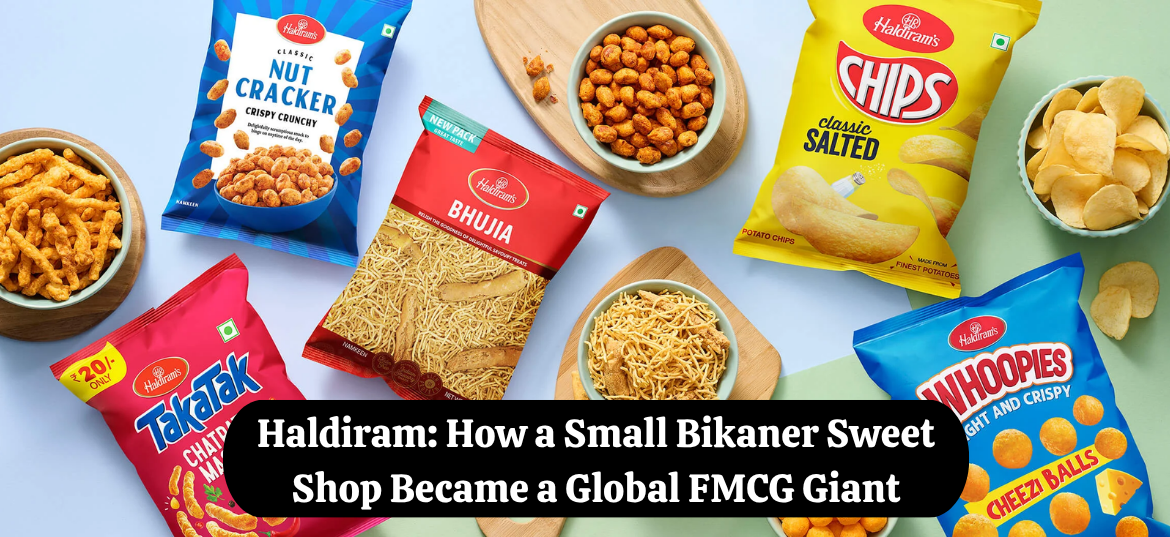
Haldiram: How a Small Bikaner Sweet Shop Became a Global FMCG Giant
Haldiram is among those rare Indian brands that scaled without noise, venture capital, or aggressive advertising relying purely on consistency, quality, and timeless consumer trust. What began in 1937 as a tiny namkeen and sweets shop in Bikaner is today a ₹12,000+ crore global food conglomerate with a presence in more than 80 countries, hundreds of products, and a consumer base that spans generations.
But the Haldiram story is not about food alone. It is a case study in brand discipline, family-led execution, and adapting without losing authenticity.
Origin: A 13-Year-Old Entrepreneur’s Dream
The journey began with Shri Ganga Bhishen Agarwal (Haldiram Ji), who started experimenting at just 13 years old with the traditional bhujia recipe.
He quickly realised three things:
- The product had mass appeal
- No one was selling it at scale
- Consistency would be a major differentiator
He refined the classic Bikaneri bhujia making it crisper, thinner, and more flavourful. This single product became the foundation of a brand that would later reach every Indian home.
Expansion: From One Shop to a Family Empire
Between the 1960s and 1980s, the brand expanded from Bikaner to Kolkata, where Haldiram outlets became iconic. Later, various members of the Agarwal family ventured into Delhi, Nagpur, and other cities.
Haldiram operates under a unique family-led multi-entity structure:
- Haldiram Delhi
- Haldiram Nagpur
- Haldiram Kolkata
Each operates independently yet follows the same overarching brand philosophy. Despite decentralization, consumers experience Haldiram as one unified brand a rare advantage in FMCG.
3. The Growth Curve: Why Haldiram Won
a) Hyper-focus on Quality
Before most Indian food brands modernized, Haldiram had already set up factory-grade processes. Automated lines, standardized recipes, and strict sourcing ensured every packet tasted identical.
b) Category Leadership
Long before global giants entered India, Haldiram already dominated key categories:
- Namkeen
- Sweets
- Ready-to-eat snacks
- Frozen foods
- Fast-food restaurants
This early leadership allowed it to build deep defensive moats.
c) Multi-price Strategy
Haldiram mastered India’s diverse market by serving all price segments:
- ₹5 and ₹10 packs for value-conscious consumers
- Premium nuts, gifts, and sweets for festive buyers
- Restaurant-style meals for families
This ensured a customer base ranging from local kirana shoppers to the global Indian diaspora.
d) Desi Taste, Global Scale
Haldiram doubled down on authentic Indian flavours, while western brands pushed global tastes. Iconic products like:
- Aloo Bhujia
- Kaju Katli
- Moong Dal
- Bhelpuri
- Rasmalai
accelerated the brand’s global success especially among NRIs who craved the taste of home.
4. Product Innovation & Manufacturing Strength
Although not loud about innovation, Haldiram continuously expands into new categories:
- Ready meals
- Frozen parathas
- Sugar-free sweets
- Instant mixes
- Fusion snacks
Its manufacturing plants in Delhi, Noida, Nagpur, and Gurgaon some over 1,00,000 sq. ft — give it a huge competitive edge:
- High scalability
- Pricing power
- Strong distribution
- Export efficiency
Global Expansion: Becoming an Indian Food Ambassador
Haldiram exports to:
- USA
- Middle East
- UK
- Europe
- Australia
- Southeast Asia
In many international markets, Haldiram dominates Indian grocery shelves just as Pepsi or Nestlé dominate mainstream aisles.
The brand has become one of the top global ethnic snack brands, helping introduce Indian flavours to international consumers.
Estimated Financial Performance (FY 2024–25)
| Metric | Estimated Value |
| Revenue | ₹12,000–13,000 crore |
| Global Presence | 80+ Countries |
| Product Portfolio | 400+ SKUs |
| Employees | 10,000+ |
Lessons for Entrepreneurs
1. Obsess Over One Great Product
The entire empire began with one perfected product — bhujia.
2. Prioritise Quality Over Marketing
Consistency built trust, and trust created lifelong customers.
3. Scale Gradually and Dominate Each Market
Each new region was entered only when operations were ready.
4. Diversify, But Stay Authentic
Every new category reinforced its core identity: Indian taste.
5. Build Strong Systems Behind the Scenes
Automation and backend excellence enabled rapid growth without compromising taste.
Conclusion
Haldiram proves that building a billion-dollar Indian brand doesn’t require celebrity endorsements or flashy campaigns. It requires:
- A timeless product
- Relentless consistency
- Deep consumer insight
- Quality that never slips
From a modest Bikaner shop to a global FMCG powerhouse, Haldiram stands as one of India’s most inspiring business success stories a case study every entrepreneur can learn from.
Read more case study here.