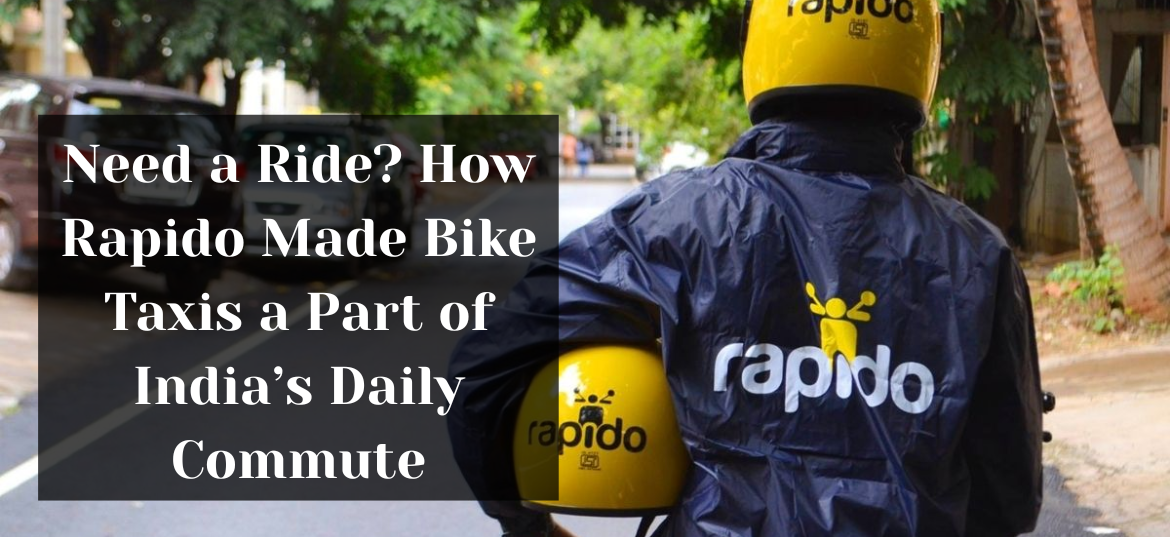
Need a Ride? How Rapido Made Bike Taxis a Part of India’s Daily Commute
Introduction
In Indian city life, where traffic is a part of daily life and public transport is in short supply, finding a trustworthy and affordable means to move short distances has always remained a challenge. While ride-hailing giants like Ola and Uber dominated the cab market, they overlooked one important aspect of Indian commuting: the power of two-wheelers.
This was the void that gave rise to Rapido , India’s biggest bike-taxi startup, in 2015. Rapido, in just a decade, has become a household name itself, clocking millions of users in over 100 cities. It’s more than just offering cheaper travel, though. It’s the transformation of urban mobility, giving millions of bicycle owners a new source of income, and defining a whole new category in India’s ride-hailing economy.
Founding Story: An Idea Comes to Life
Rapido was started by Aravind Sanka , Rishikesh SR, and Pavan Guntupalli in Bengaluru. The three of them saw a simple reality: luxury or not, cars get trapped in traffic jams, but two-wheelers can zip through narrow lanes and deliver people faster.
Their aim was simple:
- Fix the last-mile connectivity issue with the help of bikes that can be used as taxis.
- Provide cheap rides to price-conscious commuters in India.
- Offer additional income chances to millions of bike owners, whom Rapido refers to as “Captains.”
But implementation wasn’t simple. Persuading customers to travel with a stranger, making them safe, and handling legal hurdles needed tremendous perseverance. The founders took baby steps about technology, offering helmets, and covering riders with insurance. Gradually but consistently, trust increased, and Rapido emerged as a go-to option for swift, cost-effective rides.
Business Model: The Engine Behind Rapido
Rapido follows a bike-taxi aggregator model , which brings riders in touch with bike owners through a mobile application.
Revenue Model :
- Commission: Rapido charges approximately 15–20% commission per ride.
- Subscription: Captains have options to avail daily/weekly subscription passes for higher earnings.
- Diversification: Businesses such as Rapido Auto , Rapido Rentals , and Rapido Local Delivery bring additional revenue streams.
Value Proposition :
- For riders: Less expensive than cabs , quicker than autos, and readily available.
- For Captains: Flexible work , immediate income, and the opportunity to earn from their bikes.
This double value proposition enabled Rapido to grow rapidly in cities where car rides were typically out of reach and public transport was unreliable.
Market Opportunity: Why Rapido Made Sense in India
Three drivers powered Rapido’s success:
- Traffic congestion : Metro cities in India are among the most congested globally. Bikes provided the quickest fix.
- Two-wheeler ownership : India had more than 200 million bikes , so the supply side was already there.
- Affordability : In a place where cost is important, bike-taxis were usually 30–40% less expensive than cabs.
As Ola and Uber concentrated on cars, Rapido identified this niche and doubled down.
Growth Journey: From Startup to Market Leader
- 2015: Rapido goes live in Bengaluru with only a few riders.
- 2016–17 : Grows to 10+ cities, gains trust with safety helmets and insurance.
- 2019 : Tops 10 million customers , raises capital from WestBridge and Nexus Ventures.
- 2020 : COVID-19 suspends rides, but Rapido shifts to last-mile deliveries with Swiggy, BigBasket, and Flipkart.
- 2021–22 : Launches Rapido Auto and Rapido Rentals , grows fast in Tier-2 and Tier-3 cities.
- 2023–24: Geographical presence in 100+ cities , achieves over 100 million rides per year, and moves closer to profitability in major markets.
Product Ecosystem: Beyond Bike-Taxis
Rapido has expanded its repertoire to function as a multi-service platform :
- Rapido Bike – Primary bike-taxi trips.
- Rapido Auto – Direct competitor of Ola and Uber’s auto services.
- Rapido Local/Delivery – Last-mile transportation for e-commerce and food delivery companies.
- Rapido Rentals – Hourly rental service with multiple stops for errands and city travel.
This ecosystem prevents Rapido from becoming too reliant on bike rides alone, allowing it a cushion against regulatory or demand shocks.
Challenges and Roadblocks
Rapido’s progress wasn’t smooth.
- Regulatory hurdles : Most states, including Karnataka and Maharashtra, raised doubts about the legality of bike-taxis. Rapido encountered bans, court cases, and intense lobbying.
- Customer trust : Reliability and safety were early concerns. The company addressed these through background verification, insurance cover, and helmet mandates .
- Competition: Ola and Uber moved into the bike-taxi segment, but Rapido’s low commissions and emphasis on tier-two cities provided it with the lead.
- Rapido remained steadfast despite these hindrances and adjusted to evolving circumstances.
Marketing & Branding: The Common Man’s Commute
Rapido has established its brand on being affordable, reliable, and relatable .
- Endorsements from celebrities : Advertisements with Allu Arjun and Ranveer Singh increased visibility.
- Hyperlocal campaigns : Targeting Tier-2 and Tier-3 cities with local messaging.
- Referral & discount schemes : Driving adoption among first-time users.
- Mass positioning : Rapido positioned as the common man’s commute , emphasizing affordability over luxury.
Lessons for Entrepreneurs
Rapido’s tale has some important takeaways for startup founders:
- Identify the underserved niche– Ola and Uber were racing after cars, Rapido created an empire on bikes.
- Be flexible – The COVID delivery pivot sustained Rapido.
- Localize intensely– Small city expansion provided Rapido with a strong user base outside of metros.
- Crack affordability – In India, affordability rules. Rapido knew that better than its competitors.
- Regulations matter – Policy navigation is just as important as tech building in regulated sectors.
Conclusion
Rapido’s trajectory from a Bengaluru startup to India’s leading bike-taxi platform is an exemplification of the strength of good ideas done simply . By emphasizing affordability, speed, and mass-market appeal, Rapido built a billion-dollar category that even behemoths like Ola and Uber couldn’t overwhelm.
The resilience of the company in the face of regulation, competition, and changes in the market puts it in the list of India’s most interesting mobility success stories. In so many ways, Rapido shows that in India’s startup scene,the shortest way to success may be to move on two wheels.